Have you ever wondered where Ransomware came from? Our latest Infographic reveals this and so much more.
What was the first recorded example of Ransomware and how was it administered? When did it officially become ‘Ransomware as a Service?’ How was this technology spread before the Internet? These are just a few of the questions commonly asked around the latest business threat.
We’ve created this infographic to answer these common queries, but if there’s anything else you’d like to know feel free to contact the team using the contact form below.
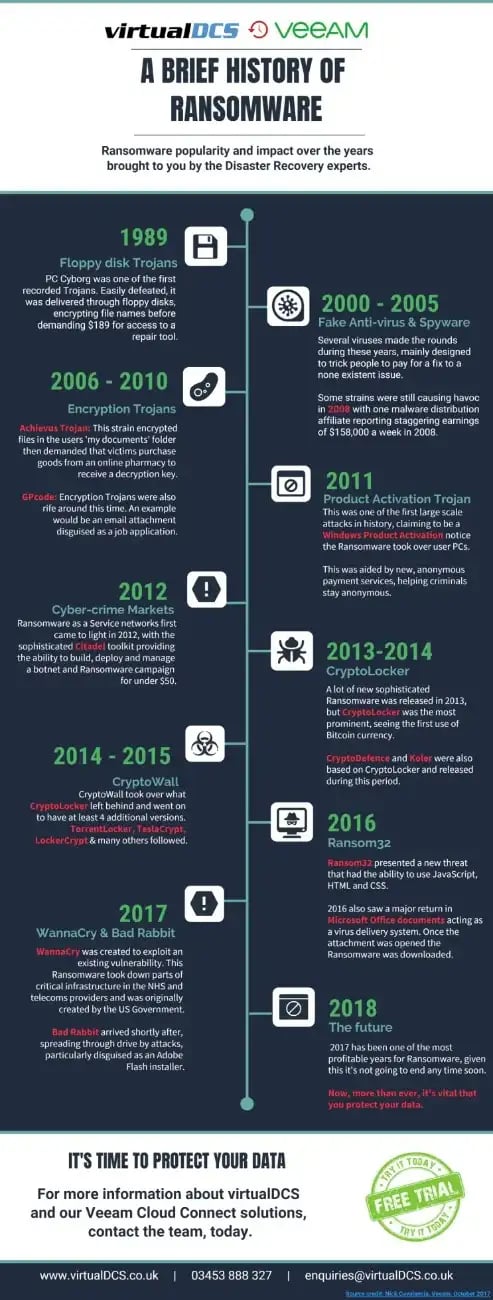
1989 | Floppy disk Trojans
PC Cyborg was one of the first recorded Trojans. Easily defeated, it was delivered through floppy disks, encrypting file names before demanding $189 for access to a repair tool.
2000-2005 | Fake Anti-virus & Spyware
Several viruses made the rounds during these years, mainly designed to trick people to pay for a fix to a none existent issue.
Some strains were still causing havoc in 2008 with one malware distribution affiliate reporting staggering earnings of $158,000 a week in 2008.
2006-2010 | Encryption Trojans
Achievus Trojan: This strain encrypted files in the users 'my documents' folder then demanded that victims purchase goods from an online pharmacy to receive a decryption key.
GPcode: Encryption Trojans were also rife around this time. An example would be an email attachment disguised as a job application.
2011 | Product Activation Trojan
This was one of the first large scale attacks in history, claiming to be a Windows Product Activation notice the Ransomware took over user PCs.
This was aided by new, anonymous payment services, helping criminals stay anonymous.
2012 | Cyber-crime Markets
Ransomware as a Service networks first came to light in 2012, with the sophisticated Citadel toolkit providing the ability to build, deploy and manage a botnet and Ransomware campaign for under $50.
2013-2014 | CryptoLocker
A lot of new sophisticated Ransomware was released in 2013, but CryptoLocker was the most prominent, seeing the first use of Bitcoin currency.
CryptoDefence and Koler were also based on CryptoLocker and released during this period.
2014-2015 | CryptoWall
CryptoWall took over what CryptoLocker left behind and went on to have at least 4 additional versions.
TorrentLocker, TeslaCrypt, LockerCrypt & many others followed.
2016 | Ransom32
Ransom32 presented a new threat that had the ability to use JavaScript, HTML and CSS.
2016 also saw a major return in Microsoft Office documents acting as a virus delivery system. Once the attachment was opened the Ransomware was downloaded.
2017 | WannaCry & Bad Rabbit
WannaCry was created to exploit an existing vulnerability. This Ransomware took down parts of critical infrastructure in the NHS and telecoms providers and was originally created by the US Government.
Bad Rabbit arrived shortly after, spreading through drive by attacks, particularly disguised as an Adobe Flash installer.
2018 | The future
2017 has been one of the most profitable years for Ransomware, given this it's not going to end any time soon.
Now, more than ever, it's vital that you protect your data.